1 / 2
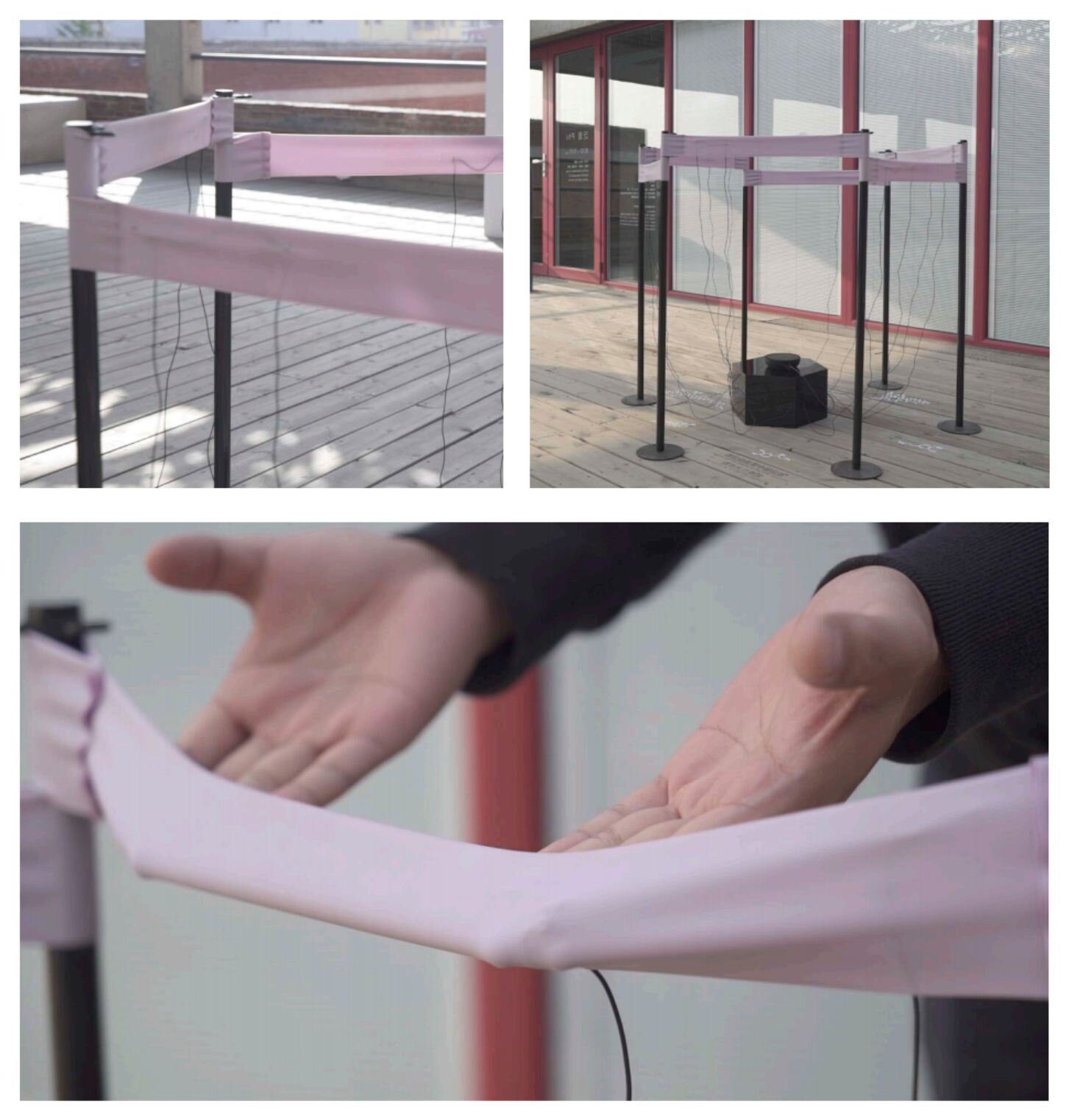
Phi is an interactive sound installation by ZHANG Wenxin and Jing Yu, made for the third-floor terrace of Taikang Space. A terrace is neither inside nor out; it has no fixed function, yet it is indispensable. The artists turned this floating quality into a layered composite space, building a sound installation on the exterior of the building that maps, in parallel, the neural information network inside the human brain. Visitors move among columnar structures and a greenhouse-like transparent tent, passing repeatedly from inside to outside — their movement itself taking part in generating the sound.
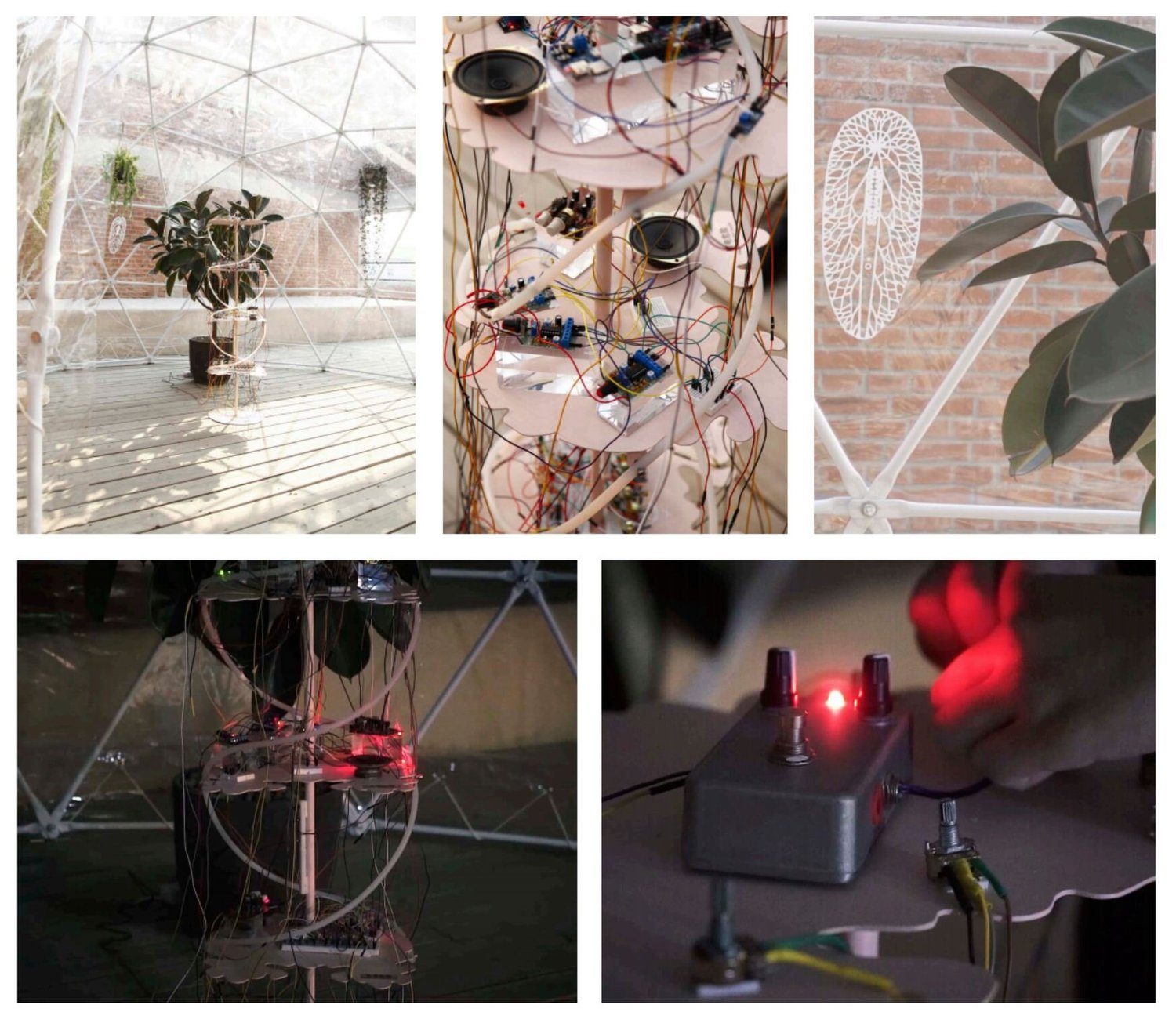
Four installations unfold in sequence. It begins with binary black-and-white game stones; then a sonic rendering of neurons exchanging charge under stimulus and craving ever stronger stimulation; then an “algorithmic” instrument whose participants pull sensors standing for six neurohormones — dopamine, oxytocin, testosterone and adrenaline among them — triggering the computer to compose in real time; and finally a hemispherical plant greenhouse modelling the neurological hypothesis that the brain is built of three concentric layers (reptilian, mammalian, neocortex), together with a speculative fourth: a human-machine coupled layer that may arrive in the near future. Each layer reaches a sounding device by different means — circuitry, or the humidity sensors of plants.
The title comes from Phi (Φ), a symbol shared by mathematics and neuroscience: the constant of the golden ratio, and also the value by which cognitive neuroscience gauges a system’s complexity and judges whether it might give rise to consciousness. For the two artists, Phi is not a grand account of a cognitive revolution but a look inward at the scale of a single body — each installation a magic mirror in which viewers glimpse a corner of their own conscious world.
《泛音》是张文心与虞菁合作的声音互动装置,为泰康空间三层的露台而作。露台介于室内与室外之间,没有确定的功能,却又不可或缺——两位艺术家把这种「漂浮」的空间感转化成一座多层复合结构,在建筑外部搭起声音装置,平行映射人脑内部的神经信息网络。观众穿行于柱状结构与温室般的透明篷房之间,时而在内、时而在外,身体的移动本身参与了声音的生成。
项目由四件装置层层递进:自二进制的黑白棋子出发;继而以声音演绎神经元受刺激后交换电荷、不断渴求更强刺激的过程;再到一件「算法」乐器——参与者拉动分别对应多巴胺、催产素、睾酮、肾上腺素等六种神经激素的感应器,触发电脑即时作曲;最终进入半球形的植物温室,其中模拟了神经学关于人脑三层结构(爬行动物脑、哺乳动物脑、智慧脑)的假设,并预设了一层可能在不久的将来出现的「人机耦合脑层」,每一层各以电路、植物湿度感应器等方式连接发声装置。
标题取自数学与神经科学共用的符号 Phi(Φ):它既是黄金分割的常数,也是认知神经科学中衡量系统复杂程度、判断其是否可能产生「意识」的数值。对两位艺术家而言,《泛音》不是对认知革命的宏大描绘,而是以个体为尺度的一次向内观看——每件装置都像一面魔镜,观者透过它瞥见自己意识世界的一角。